If you’re stepping into crypto for the first time, you’ll hear one line again and again— “Not your keys, not your crypto.”
Create a non-custodial crypto wallet gives you complete control over your funds—no company, exchange, or middleman controls your crypto, just you.
A lot of beginners feel confused in the beginning, and it’s normal. Crypto wallets sound technical, but once you understand the basics, it becomes easy—actually easier than banking apps at times.
To make things simple, I’ve broken down every point in a beginner-friendly way, using real information and trusted sources like MetaMask Docs, Coinbase Docs, and Ledger Academy.
What Is a Non-Custodial Crypto Wallet?
A non-custodial crypto wallet lets you control your private keys, so you decide what happens to your crypto at all times.
Banks hold your money.
Crypto exchanges hold your wallet keys.
But a non-custodial wallet puts everything directly in your hands.
Why Choose a Non-Custodial Wallet Over a Custodial One?
Custodial wallets (like exchanges) store your crypto for you. Sounds convenient, but here’s the catch:
- If the exchange gets hacked, your crypto is at risk at that time.
- If the exchange freezes accounts, you can’t take out your funds.
- If the exchange shuts down, your money can disappear; for example, the FTX collapse was widely covered by trusted sources like BBC & Reuters.
With a non-custodial wallet:
- You own your private keys.
- No one can freeze your money.
- No third party can control your assets.
It’s financial freedom—with responsibility.
Why Private Keys and Seed Phrases Matter
Your seed phrase (12 or 24 words) is the master key. Anyone who has it can access your entire wallet.
Lose it, and you lose access.
Share it, and your funds can vanish.
This is why wallet companies like MetaMask warn clearly:
“We cannot recover your seed phrase for you.” (Source: MetaMask Support)
Understanding How to Create a Non-Custodial Crypto Wallet
Let’s keep this simple and clear.
Creating a non-custodial wallet takes less than 3 minutes, and you don’t need any technical knowledge. I am helping to create a non-custodial crypto wallet.
Popular Wallet Options
Some trusted wallet apps recommended globally:
- MetaMask (Ethereum & other networks)
- Coinbase Wallet (multi-chain, beginner-friendly)
- Trust Wallet (supports hundreds of coins)
- Exodus Wallet (desktop + mobile)
- Ledger Nano (hardware wallet)
These apps are widely used, with millions of verified users in the world.
Also read, How to choose a secure crypto exchange.
Downloading a Wallet App Safely
Always download from official sources. Fake apps are a huge scam risk.
- MetaMask official site: metamask.io
- Trust Wallet official site: trustwallet.com
- Coinbase Wallet official site: wallet.coinbase.com
Never download from random links or YouTube descriptions.
Scam apps often steal seed phrases, and this time, you have patience and stay alert.
Setting Up Your Own and Create Non-Custodial Crypto Wallet at Home
Now let’s walk through the setup process in a simple, friendly flow.
Step 1: Install the App
Download the app from the Play Store, App Store, or official website.
Open it → tap “Create New Wallet.”
Step 2: Generate Your Seed Phrase
The app shows you 12 or 24 secret words.
This is your lifeline.
How to store it safely:
- Write it on paper (not in Notes app)
- Store multiple copies in different places.
- Avoid screenshots, cloud storage, WhatsApp, and email.
- You can use a metal seed phrase backup plate for extra safety.
Step 3: Create a Strong Password
The password protects your wallet app.
A seed phrase protects your actual wallet.
Use something strong, like:
- Mix of letters, numbers, symbols
- No birthdays
- No simple words
Step 4: Connect to Blockchain Networks
Most crypto wallets connect automatically, but some, like MetaMask, allow selecting networks:
- Ethereum
- Binance Smart Chain
- Polygon
- Arbitrum
- Avalanche
Networks allow you to interact with apps, send tokens, and explore Web3.
Also read, Crypto wallet address recovery
Features and Benefits of Non-Custodial Crypto Wallets
Let’s break down the real advantages—not the hype.
1. Full Control Over Your Crypto
You don’t rely on exchanges.
You become your own bank.
2. Better Privacy
Non-custodial wallets don’t ask for your ID, Aadhaar, PAN, or documents.
Your identity stays private.
3. Protection from Exchange Hacks
Big exchanges like Mt. Gox & FTX collapsed.
Non-custodial wallets protect you from that.
4. Access to DApps (Decentralised Apps)
You can connect instantly to:
- DeFi platforms
- NFT marketplaces
- Web3 games
This is why wallets like MetaMask are extremely popular in the crypto community.
5. Multi-Wallet Management
Apps like Trust Wallet allow you to create multiple wallets inside one app.
Useful for budgeting, storing tokens separately, and testing new networks.
Helpful Tips for Beginners Using Non-Custodial Wallets
These are real-world tips beginners often miss.
1. Never Share Your Seed Phrase
Not with friends.
Not with “support staff.”
Not with anyone.
2. Update Your Wallet Regularly
Security patches protect you from new threats.
3. Use Extra Security Layers
If your phone supports it:
- Fingerprint lock
- Face ID
- 2FA (if available)
4. Start with Small Transactions
Try sending $1–$5 worth of crypto to learn how fees, confirmations, and networks work.
5. Beware of Fake Apps and Phishing
Always double-check app logos, website links, and Chrome extensions.
Examples of Trusted Non-Custodial Wallets for Beginners
Let’s talk about the easiest ones for new users.
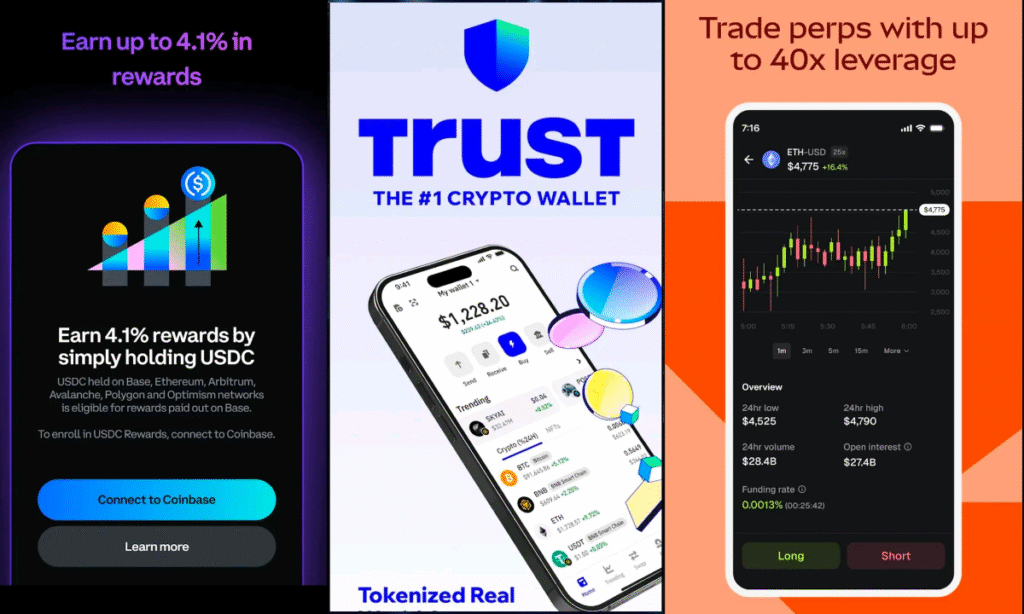
1. Coinbase Wallet—Beginner Friendly
Why people like it:
- Easy interface
- Supports multiple networks
- Built by Coinbase (one of the biggest regulated crypto companies)
2. MetaMask—Best for Web3 Users
- Great for DeFi
- Simple to create multiple accounts
- Works on mobile and as a browser extension
3. Trust Wallet—All-in-One App
- Supports thousands of assets
- Built-in staking
- QR scanning, DApp browser
These are safe and popular choices used by millions globally.
Troubleshooting Common Issues with Non-Custodial Wallets
Even pros make mistakes. Here are solutions.
1. How to Recover Your Wallet
If you reinstall your app or change your phone:
- Open the app
- Click “Import Wallet.”
- Enter your 12/24-word seed phrase.
Your wallet comes back instantly.
2. What If You Lose Private Keys?
If you lose your private keys but still have your seed phrase, you are safe.
If you lose both, recovery becomes impossible.
This is the trade-off of full ownership.
3. Avoiding Common Mistakes
- Sending funds on the wrong network
- Clicking scam airdrop links
- Storing seed phrase online
- Using public Wi-Fi for transactions
Always double-check addresses and network settings before sending funds.
My Personal Opinion on Creating a Non-Custodial Crypto Wallet
To be honest, the first time I created a non-custodial wallet, I felt a little nervous. When the app showed me the seed phrase, it hit me that these 12 words are everything. If I lose them, I lose access to my crypto. That moment actually made me understand how real ownership works in the crypto world.
But after setting it up properly, I noticed something —
Having full control over your funds feels surprisingly empowering.
No exchange can freeze your account, no third party can touch your assets, and no sudden shutdown can trap your money. It’s just you and your wallet. That sense of independence is something you don’t get with custodial wallets.
I personally treat my seed phrase like my most valuable asset.
I keep it written on paper in two different safe places. I never store it online, not even in notes or cloud backup, because I’ve seen so many people lose their funds due to simple mistakes.
At first, the whole process might look a bit technical to beginners, but once you go through it, you realize how simple it actually is. After a few days, opening the wallet, checking balances, and connecting to dApps become as normal as using any other app on your phone.
If I had to give beginners one honest suggestion, it would be this:
Creating a non-custodial wallet is the smartest step if you truly want control over your crypto—but you must protect your seed phrase like it’s your digital life.
That’s the main lesson I’ve learned.
More control always comes with more responsibility, and in crypto, that responsibility is completely worth it.
Conclusion: Take Control of Your Crypto Safely
Creating a non-custodial crypto wallet is one of the simplest yet most powerful things you can do in your crypto journey.
It gives you real ownership, stronger security, and complete freedom to interact with Web3.
Just remember three things:
- Protect your seed phrase.
- Use trusted wallet apps.
- Start small and learn gradually.
Once you get used to it, managing your wallet becomes as normal as using UPI—बस thoda dhyan rakho, and you’re good.
FAQ – Frequently Asked Questions
1. What is the difference between custodial and non-custodial wallets?
Custodial wallets hold your crypto for you. Non-custodial wallets give you full control of your keys.
2. Can I recover my wallet if I lose my seed phrase?
No. Without the seed phrase, recovery is not possible.
3. Are non-custodial wallets safe for beginners?
Yes, as long as you store your seed phrase securely and avoid scam links.
4. How many wallets can I create with one seed phrase?
You can create multiple accounts inside one wallet, but never share the seed phrase.
5. Is it free to create a non-custodial wallet?
Yes. MetaMask, Trust Wallet, and Coinbase Wallet are all free to create.

Muddu – Crypto Enthusiast & Analyst
Muddu has been actively involved in the crypto world for more than 3 years, closely tracking Bitcoin, altcoins, and emerging blockchain projects. With hands-on experience in crypto trading, market analysis, and following global regulations, he simplifies complex crypto trends into easy-to-understand insights for readers.
Through FastCryptoBuzz, Muddu aims to bring honest, research-driven, and timely crypto updates that help readers stay ahead in the fast-moving digital asset space. His mission is to make crypto knowledge accessible to everyone – from beginners to seasoned investors.
“Crypto is not just about coins, it’s about building the future of finance.” – Muddu